The JGM-44 was a one-of-a-kind computer, hand-built by my father during the “hobbyist” era from about 1978 to 1986. It would eventually feature switchable (non-simultaneous) operation of either a Motorola MC6809 or a Zilog Z-80 CPU, dual 8” 241KB floppy drives, 64K of RAM, and a sound card capable (by 80s standards) of both music and speech.
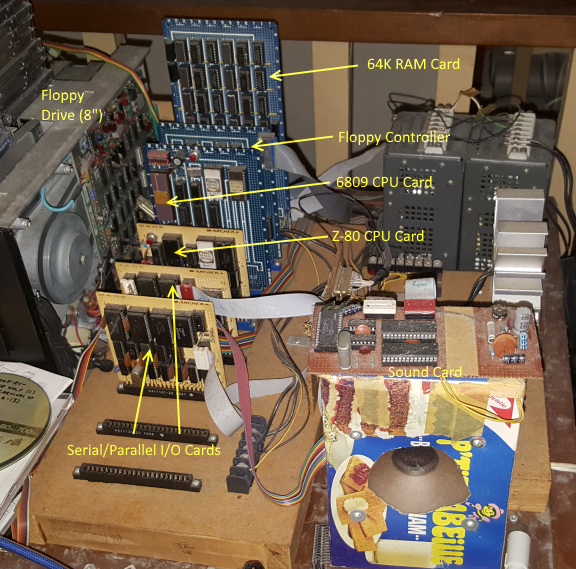
JGM-44 Microcomputer
(The term ‘JGM-44’ properly refers to the bus architecture, not the computer itself. But since this is the only computer in the world that ever used this architecture, and there isn’t a proper name for the computer itself, I’m taking liberties.)
The JGM-44 was significantly upgraded over the course of its life. The first version used a Motorola MC6802 CPU. (Note: This is not the same as the more famous MOS 6502 that was used in the Apple ][ and Commodore PET.) The 6802 was significantly easier to build than a 6800 (or 6502) because it included an on-chip oscillator. It also included 128 bytes of on-board RAM, meaning it was immediately able to run very simple programs, even before the RAM board was finished.
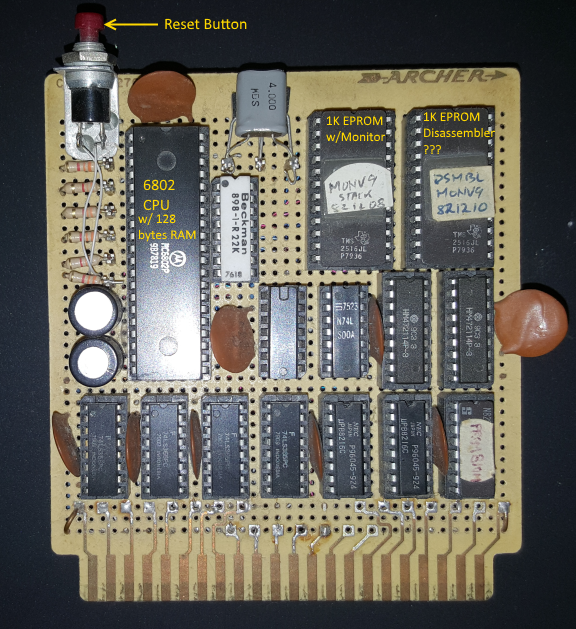
6802 CPU Board
The EPROMs shown here are the final set, dated 1982, used with this board. They include the Motorola ROM monitor (JBUG? MikBUG?), and a second 2K EPROM labeled ‘DSMBL’ - a ROM disassembler? What luxury!
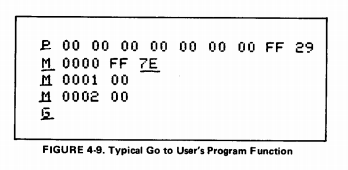
Running a Program
To run a program, you used the M command to modify bytes of memory, then the G command to “go”. (The example shown above is just changing a variable and launching the program at FF29. Entering a program would be much longer.)
I remember writing the “guess a number from 1 to 100” game for this board. Of course it couldn’t actualy give that as a prompt, since it’s a 28-byte string - which would be 22% of the entire RAM of the system. It had to ask you things like “G?”. I remember the looping and branching, but I don’t remember how I got the random numbers. Maybe I counted in a loop while waiting for the first user input, or something. More likely it just wasn’t actually random and the answer was always 57. It also seems likely that the game was really “guess a number from 00 to FF” because I don’t think it would have been feasible to do translation to, or particularly from, decimal. At least, not at my skill level at the time.
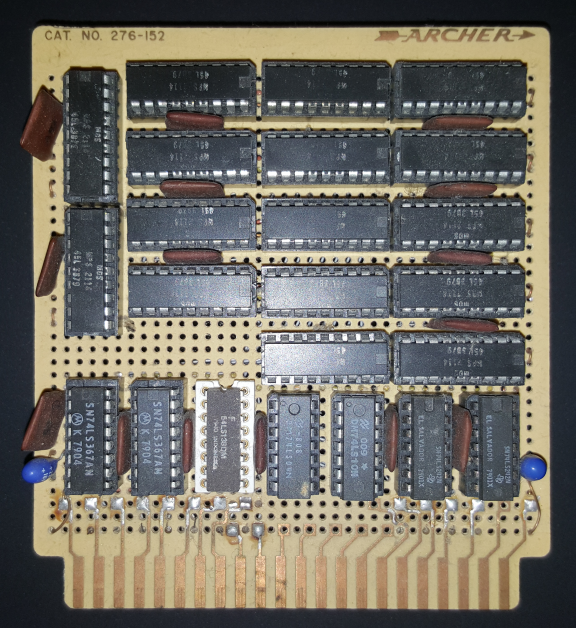
8K RAM Board
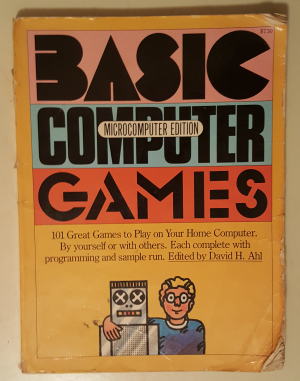
The next major improvement was the 8K RAM board. This was just enough to run the smallest available BASIC interpreter. (Well, there was such a thing as 4K BASIC on the TRS-80, but it was really primitive. Like, maybe it didn’t have multiplication.) I quickly abandoned hand-assembling 6802 opcodes by poring through databooks, and started to write BASIC programs. I recall that my father had second thoughts about “getting a BASIC interpreter too soon” - he thought I should have spent more time doing real work in machine language, and that I wasn’t learning anything with this BASIC nonsense.